
You step into the shower expecting hot water and get a blast of ice instead. It’s a rough way to start the morning, and it usually means something in your water heater has quit on you.
Here’s the good news. Most heating failures trace back to a short list of causes, and a few of them you can check yourself in about ten minutes. The bad news is that some symptoms aren’t a repair you schedule for next week. They’re the kind you deal with today.
This guide walks you through water heater troubleshooting the practical way: what’s likely wrong based on what you’re seeing, which checks are safe to try, and the seven warning signs that mean you should stop poking around and pick up the phone.
What This Guide Covers
- Water Heater Troubleshooting Chart
- How Your Water Heater Actually Works
- Water Heater Not Heating? Start With Your Symptom
- The 7 Emergency Signs: Stop Water Heater Troubleshooting and Call
- Safe DIY Checks You Can Try First
- Water Heater Elements: How to Spot a Failure
- Repairs You Shouldn't Take On Yourself
- Repair or Replace? A Simple Way to Decide
- Preventing Problems Before They Start
- Getting It Sorted
- Frequently Asked Questions
Water Heater Troubleshooting Chart
| What You’re Seeing | Likely Cause | DIY or Call? |
| No hot water at all | Tripped breaker, pilot out, upper element failed | Try DIY first |
| Water is lukewarm | Faulty thermostat, one dead element, crossed plumbing | Try DIY first |
| Hot water runs out fast | Sediment buildup, lower element failed, dip tube broken | Call |
| Popping or rumbling sounds | Hardened sediment on the tank floor | Call |
| Rotten egg smell near the unit | Gas leak | Call immediately |
| Puddle around the base | Tank corrosion or failed fitting | Call immediately |
| Rusty or brown hot water | Anode rod spent, tank rusting inside | Call |
| Water too hot to touch | Thermostat or gas valve stuck | Call |
| Pilot won’t stay lit | Bad thermocouple or dirty pilot assembly | Try DIY once |
| Breaker keeps tripping | Shorted element or wiring fault | Call |
How Your Water Heater Actually Works
Knowing the basic layout makes every symptom easier to read. There isn’t much to these units, which is why most water heater problems trace back to the same handful of parts.
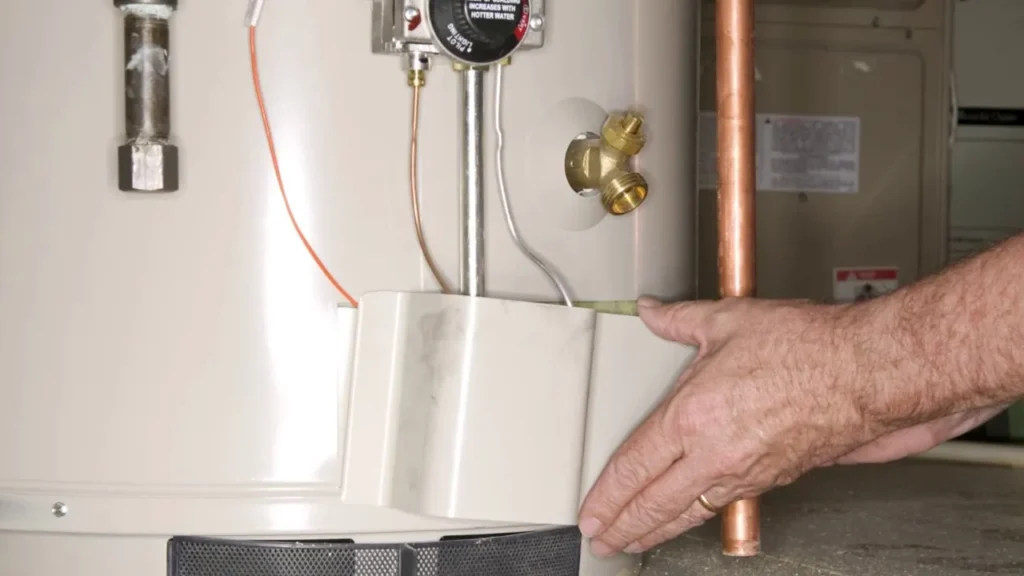
Gas Storage Tanks
A burner sits under the tank and fires when the thermostat calls for heat. A thermocouple senses the pilot flame and tells the gas control valve it’s safe to keep gas flowing. Exhaust leaves through a flue at the top.
Inside, a dip tube pushes incoming cold water to the bottom so it doesn’t mix with the hot water waiting at the top. An anode rod hangs in the tank and corrodes on purpose so the steel walls don’t.
Electric Units
Electric models skip the burner entirely. Instead, two heating elements screw into the side of the tank, each paired with its own thermostat. A high-limit switch with a red reset button sits behind the upper access panel as a safety cutoff.
Tankless Systems
Tankless units heat on demand through a heat exchanger, triggered by a flow sensor when you open a tap. No storage means no sediment sitting on a tank floor, but mineral scale still builds inside the exchanger and needs flushing.
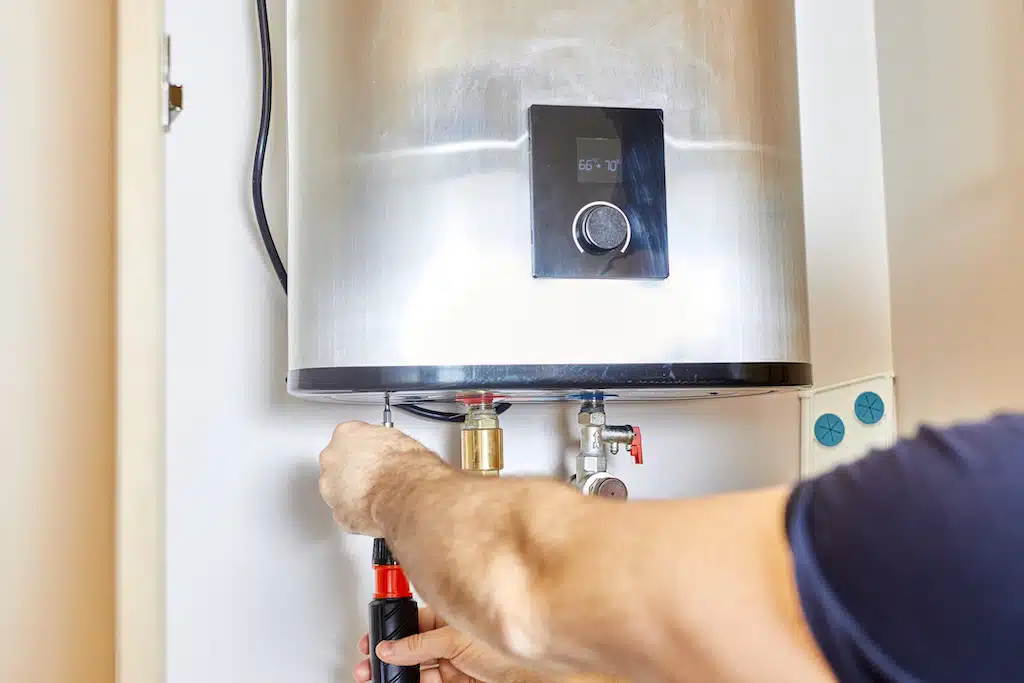
Water Heater Not Heating? Start With Your Symptom
Good water heater troubleshooting starts with the symptom, not the part. Match what’s happening at your faucet to the sections below and each one narrows the problem down fast.
No Hot Water At All
On an electric unit, this usually points at the breaker or the upper element. The upper element heats the top of the tank, so when it dies, you get nothing hot even though the lower one may still be working.
On a gas unit, check whether the pilot is lit. A pilot that keeps going out almost always means a failing thermocouple.
Water Is Lukewarm But Never Hot
One dead element or a drifting thermostat is the usual culprit. The unit still produces heat, just not enough of it to reach the setpoint.
If your home has a mixing valve or a recirculation loop, a stuck valve can also blend cold water into the hot line and give you the same result.
Hot Water Runs Out Too Fast
This one is almost always sediment or a failed lower element. Minerals settle at the bottom of the tank, insulate the burner from the water above it, and effectively shrink your usable capacity.
A cracked dip tube causes the same symptom for a different reason. Cold water dumps in at the top instead of the bottom and mixes straight into what you’re drawing.
Water Takes Forever to Reheat
Slow recovery points at a partially failed element, a burner that isn’t firing cleanly, or a thick sediment layer soaking up heat before it reaches the water.
Water Is Scalding Hot
A thermostat stuck closed or a gas control valve that won’t shut off will keep heating past the setpoint. Turn the temperature down and see if anything changes. If it doesn’t, treat it as urgent.
Hot Water Smells or Looks Off
A sulfur smell in hot water only, not cold, usually means bacteria reacting with a depleted anode rod. Brown or rust colored water is a different story and points at the tank itself breaking down.
The 7 Emergency Signs: Stop Water Heater Troubleshooting and Call
Everything above gives you room to investigate. These seven don’t. If you spot any of them, shut things down and get emergency water heater repair in Sacramento on the way.
1. Water Pooling Around the Base
A puddle at the bottom of the tank means the steel wall has corroded through. Tank leaks never seal themselves, and the opening only widens as pressure keeps working on it.
Shut off the water supply valve above the unit and cut the power or gas. A slow drip today can become a flooded floor overnight.
2. A Rotten Egg or Sulfur Smell Near the Unit
Natural gas is odorless, so utilities add a sulfur scent specifically so you’ll notice a leak. Smelling it near your water heater is not a plumbing inconvenience. It’s a safety situation.
Don’t flip switches, don’t light anything, and don’t try to find the source. Leave the house, then call the gas utility and a plumber from outside.
3. The TPR Valve Is Discharging or Hissing
The temperature and pressure relief valve is the last defense against a tank that’s over pressurized. When it opens on its own or vents steam, it’s doing its job because something upstream has failed.
Never cap, plug, or tighten a discharging TPR valve. That valve is what keeps a pressurized tank from becoming dangerous.
4. Scalding Water You Can’t Turn Down
If lowering the thermostat doesn’t bring the temperature down, the control has failed and the unit is heating without a limit. That’s a real burn risk, especially in a house with kids or older adults.
Shut off power or gas to the unit until someone can look at it.
5. Rusty or Brown Hot Water
When the anode rod is used up, the tank lining becomes the next thing to corrode. Rust colored water coming only from the hot side is a sign that process is already underway.
Catching it early sometimes means an anode replacement. Waiting usually means the tank.
6. Loud Banging With a Bulging Tank
Popping and rumbling on their own point at sediment. Combine those sounds with any visible swelling or deformation of the tank and you’re looking at a unit under stress it wasn’t built for.
Stop using it and get it inspected.
7. Soot, Scorch Marks, or Backdrafting
Black soot around the burner area, scorching near the flue, or exhaust rolling back into the room means combustion gases aren’t venting properly. Carbon monoxide is the risk here, and it gives you no warning on its own.
Ventilate the space, leave, and have the venting checked before the unit runs again.
Safe DIY Checks You Can Try First
If you’ve been searching how to fix a water heater yourself, this is where to start. None of these require opening a gas line or working inside a pressurized tank.
Reset the High Limit Switch
On electric units, pop off the upper access panel and pull back the insulation. Press the red reset button. If it trips again right away, something is shorting and you’re done troubleshooting.
Check the Breaker
Sounds obvious, but a water heater breaker can trip without taking anything else with it. Flip it fully off, then back on.
Relight the Pilot
Gas units have relighting instructions printed on the label. Follow them once. If the pilot lights but drops out within a minute, the thermocouple is the likely problem and that’s a parts job.
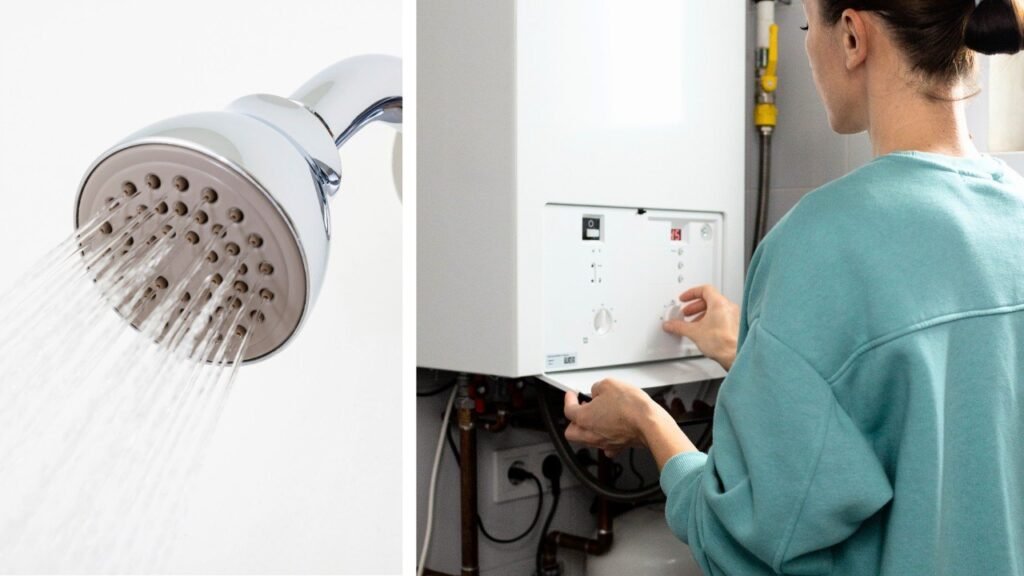
Verify the Thermostat Setting
Set it to 120°F. That’s hot enough for household use, gentle on the tank, and far less likely to scald anyone.
Flush Some Sediment
Hook a hose to the drain valve, run it outside or to a floor drain, and let a few gallons out. Cloudy or gritty water tells you sediment is a factor in whatever you’re dealing with.
Water Heater Elements: How to Spot a Failure
Water heater elements are one of the most common failure points on electric units, and the symptoms tell you which one gave out.
Upper vs Lower Element
A dead upper element means no hot water at all, because the top of the tank never heats. A dead lower element gives you a small amount of hot water that disappears quickly, since only the top portion is getting warm.
That single distinction saves a lot of guessing.
Testing With a Multimeter
With power off at the breaker, disconnect the wires and put your meter across the element terminals on the resistance setting. A working 240 volt element typically reads somewhere in the range of 10 to 16 ohms.
No reading at all means an open element. A reading between a terminal and the tank body means it’s shorted to ground.
Why Elements Burn Out Early Here
Scale coats the element and traps heat against the metal instead of transferring it into the water. The element runs hotter than designed, and it fails sooner. Homes with harder water go through elements faster for exactly this reason.
Repairs You Shouldn’t Take On Yourself
Some jobs carry consequences that outweigh saving an afternoon.
Gas line connections, gas control valve replacement, and anything touching the flue or venting fall in this group because the failure mode is carbon monoxide or fire. TPR valve replacement on a pressurized tank belongs here too.
Same goes for panel level electrical work and any repair on a tank that’s actively leaking. At that point you’re not fixing a component, you’re managing a failing vessel.
Repair or Replace? A Simple Way to Decide
Age is the first filter. A unit still inside its warranty window with a single failed part is usually worth repairing, since elements, thermostats, thermocouples, and anode rods are all replaceable.
The picture changes when the tank itself is compromised. Corrosion through the wall, rust in the hot water, or a bulging shell aren’t repairs. Those are replacement conversations.
Repeat failures are the other signal. When you’ve fixed the same unit two or three times in a couple of years, the money is going into something that’s already telling you where it’s headed. Our team can walk you through water heater replacement Sacramento options when it reaches that point.
Preventing Problems Before They Start
Most water heater problems here start the same way. Sacramento water carries enough mineral content to leave its mark on the tank. Scale builds on elements and burner surfaces, and sediment settles into a hard crust on the tank floor.
Flushing the tank once a year clears most of that out before it can insulate the heat source or accelerate corrosion. It’s the single highest value thing you can do for the unit.
Check the anode rod every few years, keep the thermostat at 120°F, and make sure there’s an expansion tank if your home has a pressure regulator. Tankless owners have a parallel job, since tankless water heater descaling keeps the heat exchanger clear the same way flushing keeps a tank clean.