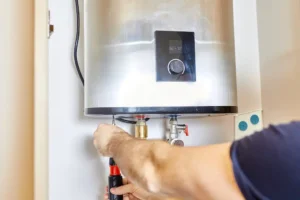

You step into the shower on a January morning in East Sacramento, turn the handle, and wait. And wait. The water never warms up.
That moment sends thousands of Sacramento County households scrambling every year, usually before coffee. The good news is that a surprising number of hot water issues trace back to something simple, a tripped button, a pilot that blew out, a screen clogged with garage dust.
Knowing how to fix a hot water heater starts with checking things in the right order, and that is exactly how this guide is laid out. Some steps you can handle in ten minutes. Others tell you to put the screwdriver down, and we’ll be clear about which is which.
What This Guide Covers
- Start Here: Five Minutes of Checks Before Anything Else
- Safety First: What to Shut Off and When
- Match Your Symptom to the Fix
- No Hot Water at All
- Water Is Lukewarm but Never Hot
- Water Is Too Hot to Use Safely
- Hot Water Tank Not Heating Enough, or Running Out Too Fast
- Hot Water Missing at Just One Fixture
- What the Noises Mean
- Discolored Water and That Rotten-Egg Smell
- Leaks: What’s Urgent and What’s Not
- How to Flush a Water Heater
- Tankless and Heat Pump Units Play by Different Rules
- Sacramento Code Details People Miss
- Repair or Replace? A Straight Checklist
- When to Stop and Call a Plumber
- Frequently Asked Questions
Start Here: Five Minutes of Checks Before Anything Else
Troubleshooting a hot water heater always starts here, with the embarrassing stuff. Plumbers get called out for these more often than anyone admits, and the fix costs nothing but a walk to the garage.
Confirm the unit actually has power or gas. Check that the breaker labeled “water heater” is fully on, not sitting in that mushy middle position that looks on but isn’t. For gas units, look through the sight glass at the base and see whether the pilot flame is burning.
Then check the thermostat setting. Somewhere between 120°F and 125°F is the sweet spot for most Sacramento homes. If someone bumped the dial to “vacation” or knocked it down during a remodel, you’ve found your problem. A surprising share of hot water issues end right there.
Safety First: What to Shut Off and When
Water heaters combine three things that don’t forgive mistakes: high voltage, natural gas, and near-scalding water under pressure. Take the thirty seconds.
For electric units, kill the breaker at the panel before you remove any access panel. The elements and thermostats stay live even when the tank isn’t actively heating, and there’s no visual cue to warn you. For gas units, turn the control knob to “off” if you plan to do anything beyond looking.
If you smell gas at any point — that sulfur, rotten-egg odor — stop. Don’t flip switches, don’t light anything. Get everyone outside and call PG&E from down the street. That one isn’t a DIY situation under any circumstances.
Match Your Symptom to the Fix
Most people land here with one specific complaint, not a diagnosis. Find yours in the left column and the rest of this guide will make a lot more sense. It is the quickest way to sort hot water issues into the ones you can handle and the ones you shouldn’t.
| What You’re Seeing | Most Likely Cause | Safe to Try Yourself? |
| No hot water at all | Tripped breaker or reset switch, pilot out, failed upper element | Yes, start below |
| Water is lukewarm, never hot | Thermostat drifted, one element down, burner running dirty | Yes |
| Hot water runs out too fast | Sediment, failed lower element, cracked dip tube | Partly |
| Water is scalding hot | Thermostat or control valve stuck open | No, shut it down |
| Takes forever to reheat | Sediment layer, weak element, undersized for the household | Partly |
| Popping or rumbling sounds | Hardened sediment on the tank floor | Yes, try a flush |
| Rusty or brown hot water | Anode rod spent, tank corroding inside | No |
| Rotten-egg smell in hot water | Bacteria reacting with the anode rod | No |
| Water pooling at the base | Tank wall corroded through | No, shut it down |
| Only one fixture runs cold | Shower cartridge or mixing valve, not the heater | Yes |
| Breaker trips repeatedly | Shorted element or wiring fault | No |
| Gas smell near the unit | Gas leak | No, leave the house |
Treat that last column as a starting point rather than a rule. A hot water heater not heating for an obvious reason is one thing, but if a check leaves you unsure at any stage, that’s the moment to stop and book water heater repair instead of pushing further.
No Hot Water at All
Why is my hot water not working at all? That is the complaint behind most calls, and it is also the one most likely to have a five-minute fix sitting behind it. Work through these in order and stop at the first one that explains what you’re seeing.
Older Sacramento homes make this easy, since the unit usually sits in a hallway closet or the corner of a detached garage. Around Land Park, Curtis Park, Oak Park, and Tahoe Park it’s rarely more than a few steps from the laundry area.
If the Pilot Is Out: How to Relight a Hot Water Heater
If the sight glass is dark, the pilot is out. Learning how to relight a hot water heater takes about five minutes and it’s the single most useful skill on this page.
Turn the control knob to “off” and walk away for ten minutes. This lets any pooled gas clear out, and skipping it is how people get hurt. Come back, turn the knob to “pilot,” press it down, and either hit the igniter button or hold a long lighter to the pilot tube.
Keep the knob pressed for a full sixty seconds after the flame catches. That gives the thermocouple time to heat up and signal the valve to stay open. Release, confirm the flame is still there, then turn the knob to “on” and listen for the main burner to fire.
If the Pilot Won’t Stay Lit
This is the most common follow-up call we get. You work out how to relight a hot water heater, the flame catches, it burns while you are holding the knob, then dies the moment you let go.
Nine times out of ten that’s a failing thermocouple — the small copper probe sitting in the pilot flame. It’s a wear part, and after a decade of cycling it stops producing enough signal to hold the valve open. Replacement is straightforward work, but it means disconnecting a supply line, so it belongs with a plumber.
The other likely culprit in Natomas, Elk Grove, and other 1990s-and-newer builds is the air intake screen at the base of the unit. Modern sealed-combustion heaters pull air through that screen, and in a garage it collects lint, dust, and cobwebs until the burner starves. A vacuum crevice tool clears it in a minute.
If the Reset Button Has Tripped
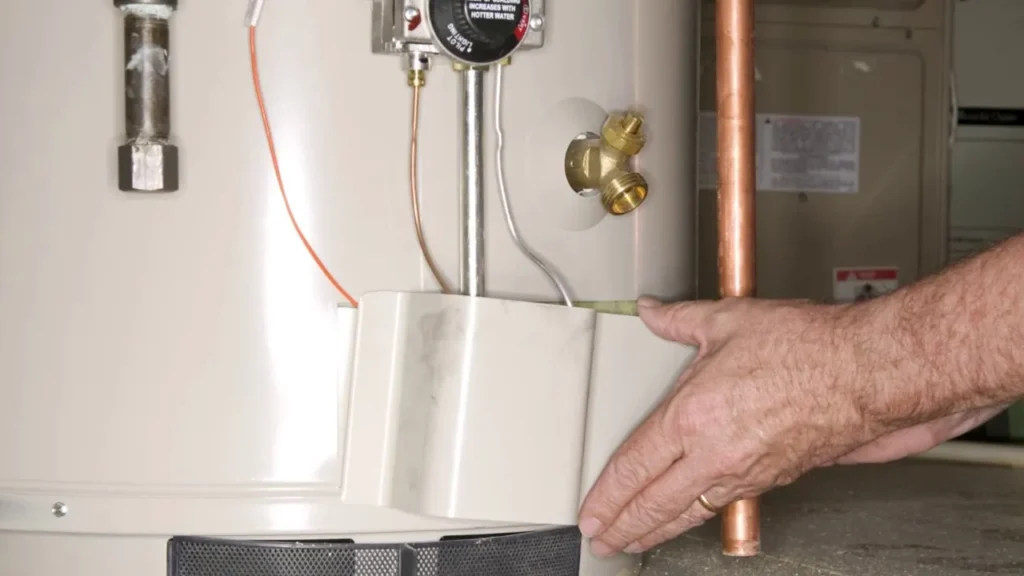
Pop the upper access panel, fold back the insulation, and you’ll see a red button on the thermostat. That’s the high-limit switch, sometimes called the ECO.
It trips when tank temperature climbs past roughly 180°F, cutting all power as a safety measure. Pressing it back in restores heat, and that single button resolves a large share of no-hot-water calls. Turn the breaker off first.
Here’s the part that matters: a reset button that trips once might be a fluke. One that trips again within a few days is telling you something upstream has failed — usually a stuck thermostat or a shorted element. Don’t keep resetting it. That’s a warning light, not a switch.
If the Breaker Keeps Tripping
A breaker that trips the moment you reset it points to a grounded element — the sheath has cracked and it’s shorting to the tank. A breaker that trips after twenty or thirty minutes of runtime is more likely a loose connection or a breaker that’s simply worn out.
Either way, repeated tripping is not something to work around. Stop resetting and get it looked at.
If It Quit After an Outage or a Trip Away
SMUD outages and planned shutoffs leave a fair number of units sitting cold once power returns, and a hot water heater not heating after the lights come back is rarely broken. Cycling the breaker fully off and back on clears most of them, though the high-limit switch sometimes trips on the way back up and needs the reset above.
A standing pilot can also blow out during a shutoff or a long vacation. And anything switched to vacation mode before a trip stays there until someone moves the dial back, so check that before you assume a part has failed.
Water Is Lukewarm but Never Hot
A hot water heater not heating fully is a different problem from one producing nothing at all. Heat is reaching the tank, just not enough of it, and that narrows the field considerably.
Reading Which Heating Element Failed
Electric tanks have two heating elements, and which one failed is written right into the symptom.
No hot water at all, ever, usually points to the upper element or upper thermostat. A tank that delivers a short burst of hot water and then goes cold means the upper element is doing its job while the lower one has quit. Lukewarm water throughout the draw suggests a thermostat calibration issue rather than a dead element.
Testing an element takes a multimeter and a continuity check across the terminals. If you’re comfortable with that, great. If the words “multimeter” and “240 volts” in the same sentence make you uneasy, that’s a perfectly good reason to hand it off.
When the Burner Is Firing but Underperforming
If the burner runs but you never get properly hot water, the control valve may be failing, or the burner assembly may be sooted up and burning inefficiently. A healthy flame is blue and steady. Yellow, lazy, or flickering means incomplete combustion.
Yellow flames also raise a carbon monoxide concern, especially in a closet installation with marginal venting. That’s a stop-and-call situation, not something to keep an eye on.
Water Is Too Hot to Use Safely
The opposite problem gets far less attention and deserves more. Water leaving the tank much above 130°F can scald in seconds, and young children and older adults have almost no margin for error.
Turn the thermostat down to 120°F and give it a few hours. If the temperature doesn’t follow the dial, the thermostat or the control valve has stuck open and the unit is heating with nothing telling it to stop.
That isn’t a wait-and-see situation. Shut off power or gas to the heater and leave it off until the control has been replaced.
Hot Water Tank Not Heating Enough, or Running Out Too Fast
There is a meaningful difference between no hot water and not enough. A hot water tank not heating to its old capacity usually is not broken at all. If your tank still produces heat but the supply quits early, its capacity or recovery rate has quietly degraded.
Why Sacramento Winters Change the Math
From December through February, the water entering your home is dramatically colder than it was in August. American River supply temperatures drop, and your heater has to work through a much wider temperature swing to hit the same setpoint.
The practical result is that a tank producing twenty comfortable minutes in summer might give you twelve in January. Nothing failed. The unit is just being asked to do more with the same burner, which is why a hot water tank not heating “like it used to” spikes as a complaint every winter.
Sediment, Hard Water, and the Slow Decline
Sacramento water sits well into the hard range, and it’s harder still in groundwater-fed areas like Elk Grove, Citrus Heights, Antelope, and parts of Rancho Cordova. Every gallon deposits a little calcium and magnesium at the bottom of your tank.
Over years that hardens into a sediment layer that steals usable volume and insulates the burner from the water above it. Your fifty-gallon tank effectively becomes a forty-gallon tank that takes longer to recover. Annual flushing is the countermeasure, and around here it matters more than the manual suggests.
A broken dip tube produces the same complaint through a different route. When that plastic tube cracks, incoming cold water dumps into the top of the tank and mixes straight into your hot supply.
Hot Water Missing at Just One Fixture
Here is the one that saves people a service call. When the kitchen runs hot but the shower doesn’t, the answer to “why is my hot water not working” has nothing to do with the tank.
Single-handle showers use a pressure-balancing cartridge that wears out over time and starts favoring the cold side. Tub spouts and older two-handle valves develop the same behavior through worn washers and seats.
The test takes a minute. Run the hot tap at whichever sink sits closest to the heater. If it’s genuinely hot there, the tank is doing its job and the problem lives in the fixture, not the appliance.
What the Noises Mean
Water heaters are supposed to be boring. When yours starts making itself heard, the sound is a decent diagnostic on its own, and it is one of the easier parts of troubleshooting a hot water heater.
Popping, rumbling, or a sound like a kettle coming to boil is almost always sediment. Water trapped under that mineral crust flashes to steam and forces its way up through the layer. It’s the single most common noise complaint in hard-water Sacramento homes, and a flush usually quiets it.
Sizzling or hissing is different, and more urgent. That’s typically water dripping onto a hot burner assembly, which means you have a leak somewhere above it. Ticking or light knocking in the pipes is usually just thermal expansion and doesn’t need attention.
Discolored Water and That Rotten-Egg Smell
Rusty or brown hot water points at corrosion, and the question is whether it’s the anode rod or the tank itself. Run the cold tap — if the cold side is clear and only the hot side is discolored, the problem is inside your heater.
The sacrificial anode rod is designed to corrode so the steel tank doesn’t. Once it’s fully consumed, the tank starts giving itself up instead, and that clock doesn’t run backward. Checking the rod every few years is the cheapest maintenance you’ll ever do.
A rotten-egg smell in hot water only is a different animal. It’s sulfate-reducing bacteria reacting with the magnesium anode, and it’s unpleasant rather than dangerous. Swapping to an aluminum-zinc rod usually clears it up for good.
Leaks: What’s Urgent and What’s Not
Water on the floor around your heater deserves a fast, calm response. First, figure out whether it’s actually leaking or just sweating — in a hot Sacramento garage in July, condensation on a cold tank can fool anyone.
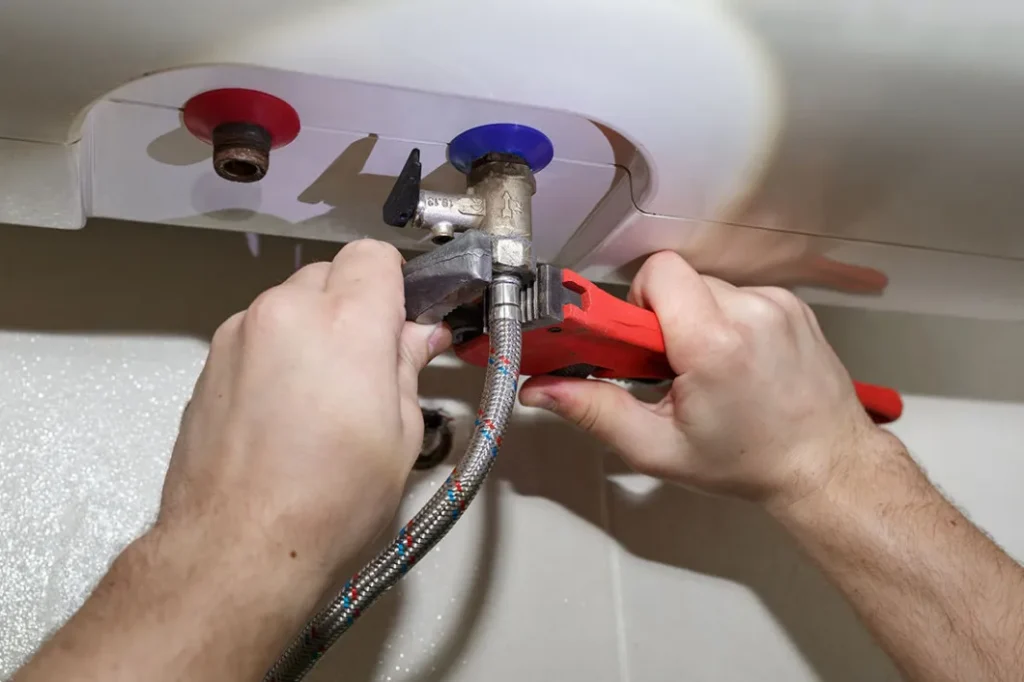
If it’s a real leak, shut the cold water inlet valve at the top of the tank and cut the power or gas. Then find the source. Drips from the drain valve at the bottom or from the inlet and outlet fittings up top are repairable. Water weeping from the T&P relief valve usually means excess pressure or temperature, not a bad valve.
Water seeping from the base of the tank itself is the one that ends the conversation. Once the inner tank has rusted through, there’s no patch for it, and replacement is the only path forward.
How to Flush a Water Heater
Flushing comes up four separate times in this guide because it clears more hot water issues than any other piece of maintenance. Here’s the actual process, start to finish.
- Shut off the gas or the breaker first, then close the cold water inlet valve at the top of the tank.
- Give the water an hour or two to cool down. Draining a tank at full temperature is how people end up with burns.
- Thread a garden hose onto the drain valve at the base and run it to a driveway, a floor drain, or a patch of yard that won’t mind the sediment.
- Open the drain valve, then open a hot tap somewhere in the house to break the vacuum and let the tank empty properly.
- Once the water runs clear, close the drain, reopen the cold inlet, and let the tank fill completely before you restore gas or power.
Two things to watch for. If the water never runs clear, the buildup is heavier than a flush can handle. And if the drain valve keeps weeping afterward, that’s a common enough outcome to be worth having swapped rather than tightened.
Tankless and Heat Pump Units Play by Different Rules
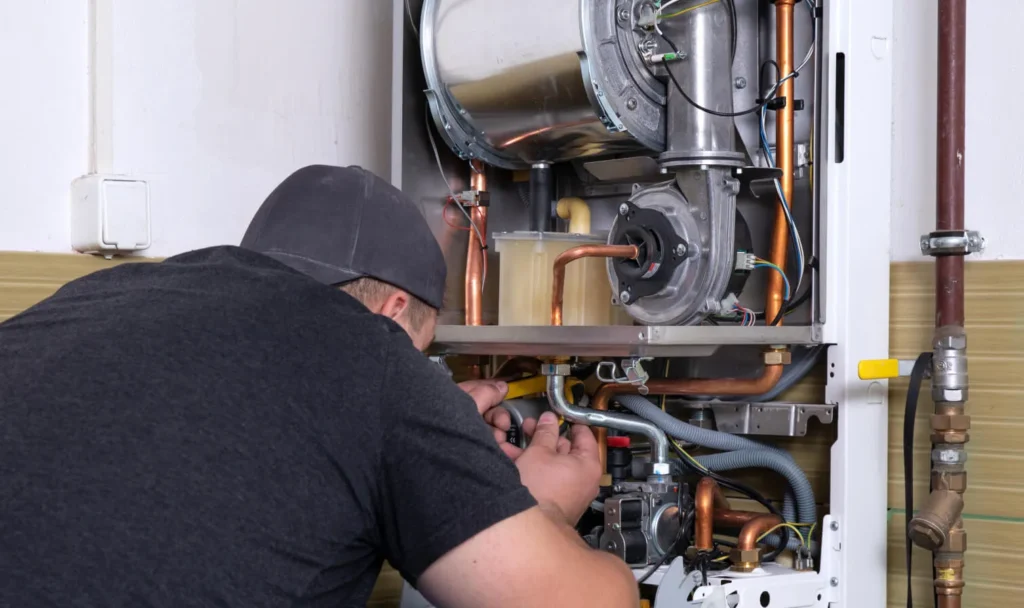
Neither of these behaves like a storage tank, so most of what is above doesn’t transfer. Knowing how to fix a hot water heater of the traditional kind won’t get you far here, and both keep showing up in more Sacramento homes.
Tankless Systems
Tankless heaters have become common in Folsom, newer Natomas construction, and Sacramento remodels. Scale is their main enemy, and our water accelerates it.
Mineral buildup on the heat exchanger shows up as fluctuating temperatures, reduced flow, or an error code on the display. Descaling on a regular schedule is not optional maintenance here — it’s the difference between a long service life and a short one.
The other frequent complaint is the “cold water sandwich,” that burst of cold mid-shower. It’s normal behavior for the technology, though a recirculation setup or a small buffer tank smooths it out considerably.
Heat Pump and Hybrid Models
SMUD rebates have pushed a lot of these into Sacramento garages, and they fail in ways a standard tank never does. The usual first sign is a unit that’s clearly running but barely keeping up with the household.
Check the air filter and the condensate drain before anything else. A blocked drain puts most units into a fault state, and a clogged filter starves the heat pump until it falls back on the backup elements and quietly doubles your energy use.
Then check which mode it’s in. Hybrid units often get switched to heat-pump-only for efficiency, and in an unheated garage in January that mode simply can’t recover fast enough for a busy morning.
Sacramento Code Details People Miss
A few local requirements catch homeowners off guard, usually at the worst possible time — during a home sale inspection.
California requires water heaters to be secured with two seismic straps, one in the upper third of the tank and one in the lower third. DIY work frequently removes them and never puts them back. Sacramento Metro AQMD also enforces low-NOx standards, which affects what unit can legally replace yours.
Water heater replacement generally requires a permit in the City of Sacramento and throughout the county, and the T&P discharge line has to terminate where it can’t scald anyone. These aren’t paperwork technicalities. They’re the details an inspector flags.
Repair or Replace? A Straight Checklist
Repeat hot water issues eventually turn into a bigger question. You don’t need a formula for it, just honest answers to a few things.
How old is the unit? Check the serial number sticker — the first four digits usually encode month and year. Given how hard our water is on tanks, Sacramento heaters tend to reach the end of their useful life sooner than the manufacturer’s estimate.
Is the tank itself compromised, or is it a component? Elements, thermostats, thermocouples, dip tubes, and anode rods are all serviceable parts. A rusted-through tank is not. And if you’ve called someone out twice in the past year for the same unit, the third repair is usually money spent delaying a decision you’ve already made.